· 3 min read
Two Hands on the Yield Curve

Last week the US Treasury started buying its own long bonds to push long yields down. This week the Fed chair said he may raise short rates. Same government, two hands, pulling the curve in opposite directions.
Read the table
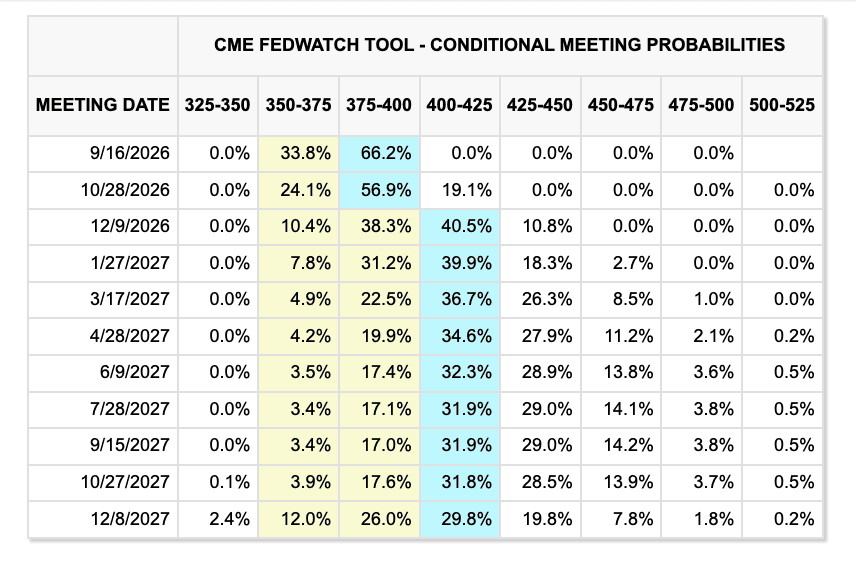
This is the market's own scorecard, and it says three things.
First, September is now roughly a two-in-three bet on a hike. A week before Jackson Hole it was a two-in-three bet on a hold.
Second, follow the blue cells. That is the most likely rate at each meeting. It steps up in September, steps up again by December, and never steps back down as the favourite. The market's question has changed from "when is the next cut" to "how many hikes."
Third, look at spring 2027 onward. The rows go flat. No single outcome gets much more than a third. That is not a forecast. It is the market admitting it does not know.
What Warsh did
Kevin Warsh's Jackson Hole speech moved hike odds from about a third to well over half in one afternoon. He called the inflation target "firm, fixed," said this summer's better readings do not show real improvement, and finished with "we have work to do." He also refused to give a path. He said he does not want markets trading off Fed guidance and called that loop a "hall of mirrors." The table is the result: no consensus beyond three months.
Gold had its best month this century in August. It fell the moment he finished speaking.
Two hands, one curve
Here is the awkward part. The Treasury is buying long bonds to hold yields down. The Fed is threatening to raise the short rate. One hand presses the long end down, the other pushes the short end up. Gavekal put it plainly: this puts the Fed at odds with the Treasury. A curve squeezed from both ends flattens, and a flat curve is what banks, borrowers and property markets like least.
The far end of the table
One more detail. By the last row, December 2027, the cut side quietly returns. About one in seven bets has rates back at or below today's level. Read that as the market's private guess: the hikes come, and then get undone. Probabilities, not predictions.
The other side
These odds flipped twice in one month. One soft jobs report or one cool inflation print flips them again. Warsh said he will not pre-commit, and banks disagree on whether the words become a hike. A table is a photograph, not a film.
Hong Kong sits in the middle of the squeeze. The twelve-month rise in home prices was built on falling HIBOR and the promise of cuts. The futures strip now points to rates roughly 40 basis points higher by January. Every H-plan mortgage in the city reprices off that. This is the first real rate test the rally has faced.
When two hands squeeze a curve from both ends, the pressure shows up in the middle. Hong Kong lives in the middle.
Jimmy Lee Ping Shan is Managing Director, Corporate Planning & Strategy at Star Group (HKEX: 1560), and writes about property, macroeconomics, and market cycles at jimmypslee.com.